



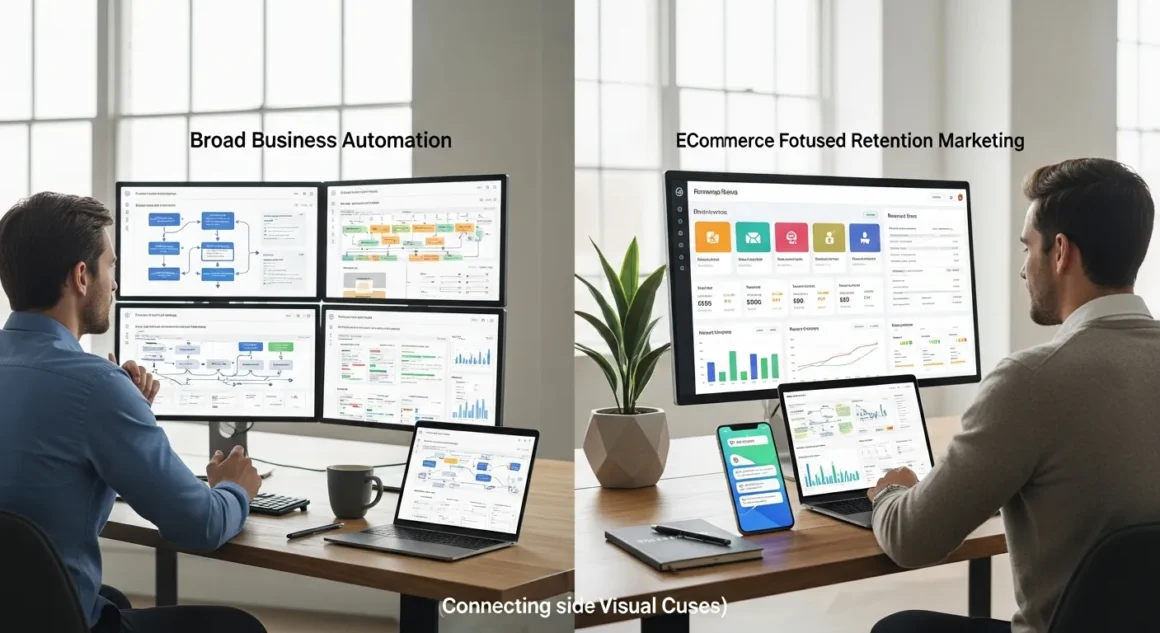
Choosing between ActiveCampaign and Klaviyo usually comes down to one question: are you trying to run broader marketing automation across your business, or are you mainly trying to drive more ecommerce revenue from email and SMS?
Both tools are strong, and both have loyal users. But they’re built with different assumptions. ActiveCampaign is the more flexible all-rounder, with CRM features, deeper workflow logic, and wider use across B2B, services, SaaS, and ecommerce. Klaviyo is much more specialized. It’s built for online stores that care about customer behavior, retention, and revenue attribution down to the campaign level.
If you want the quick verdict before you scroll: ActiveCampaign is usually the better fit for businesses that need automation beyond ecommerce. Klaviyo is often the better pick for Shopify and DTC brands that live and die by repeat purchases, abandoned carts, and lifecycle email flows. Pricing matters too, and that gap gets more noticeable as your list grows.
Let’s get into where each platform actually shines, where the annoyances show up, and which one is worth your budget.
What Sets ActiveCampaign And Klaviyo Apart

The biggest difference is focus.
ActiveCampaign is a marketing automation platform that happens to work well for email. Klaviyo is an ecommerce email and SMS platform that has expanded into customer data and personalization. That sounds subtle, but in day-to-day use it changes a lot.
ActiveCampaign is built for teams that want to connect campaigns, sales follow-up, lead scoring, CRM pipelines, forms, and cross-channel automation in one place. If your business has longer sales cycles, mixed audiences, or a need to route people through different journeys based on actions, it has a lot of room to grow. That’s also why people often compare it with broader platforms, not just ecommerce tools. If you’re weighing it against more CRM-heavy systems, this breakdown of email-first automation vs a larger revenue platform is a useful next read.
Klaviyo is narrower, but that’s not a weakness if you run an online store. Its real strength is pulling in ecommerce events fast and turning them into useful flows: browse abandonment, cart recovery, replenishment reminders, VIP segments, win-back campaigns, and product-based recommendations. It’s less interested in being your all-in-one marketing operating system.
That difference also shows up in reporting. Klaviyo puts revenue attribution front and center, which ecommerce teams love because it answers the question they care about most: did this campaign make money? ActiveCampaign’s reporting is broader and improving, especially with AI-assisted insights, but it doesn’t feel as ecommerce-native.
There’s also the setup philosophy. ActiveCampaign gives you more flexibility, but sometimes that means more configuration. Klaviyo tends to feel faster out of the gate for a store. That trade-off matters. Flexibility is great until you’re the one cleaning up a messy automation map six months later.
Email Marketing And Automation Features Compared

If email automation is the main reason you’re shopping, both tools are capable. The difference is less about whether they can automate, and more about what kinds of automation they make easy.
ActiveCampaign has the deeper automation engine overall. It supports complex branching logic, multiple triggers, lead scoring, CRM updates, and actions that go beyond email alone. For teams running nurture sequences, sales handoffs, webinar funnels, or service-based onboarding, that flexibility is a real advantage.
Klaviyo is excellent at ecommerce lifecycle automation. Its prebuilt flows are sharper for common retail scenarios, and they’re easier to connect to store behavior. You can stand up abandoned cart, post-purchase, and re-engagement sequences quickly without a lot of extra work.
For marketers following broader lifecycle and acquisition trends from sources like HubSpot’s marketing blog, the distinction is pretty clear: ActiveCampaign covers more business models, while Klaviyo is more tuned for commerce retention.
Campaign Building And Workflow Flexibility
ActiveCampaign’s campaign builder is more versatile if you need custom journeys. You can combine email, CRM actions, wait steps, goals, conditions, tags, lead scores, and different entry points into one system. That makes it powerful for non-ecommerce businesses and mixed funnels where someone might download a guide, book a demo, talk to sales, and then re-enter a nurture track later.
Klaviyo’s workflow builder is cleaner for ecommerce-focused teams. It handles the common store flows really well, and it doesn’t ask you to overthink every step. For many Shopify brands, that’s a good thing. You don’t always need a giant decision tree to recover carts or upsell a recent customer.
Still, Klaviyo can feel a bit boxed in if your business model stretches beyond product sales. If you’re trying to support B2B lead nurturing, offline sales processes, or longer relationship-based journeys, ActiveCampaign has more headroom.
And that’s where practical workflow fit matters more than feature count. Plenty of teams buy the “more powerful” tool and end up using 20% of it. Slightly painful truth.
Segmentation, Personalization, And Customer Data
Both platforms are strong here, but they emphasize different kinds of data.
Klaviyo is excellent at ecommerce segmentation because it’s built around store events and purchase behavior. You can create segments based on product views, orders, average order value, predicted next purchase, and lifecycle stage. For DTC brands, that’s incredibly useful because your most valuable audience rules usually tie back to revenue behavior, not just email clicks.
ActiveCampaign also handles segmentation well, including AND/OR logic, event-based triggers, behavioral targeting, and dynamic personalization. But it stretches further into lead scoring and broader customer journey management. If you need to segment by engagement, sales stage, form activity, or CRM status, it’s often the more adaptable tool.
This also affects how useful the data feels. Klaviyo’s data model is easier to translate into retail actions. ActiveCampaign’s is more flexible across industries. If your team blends email with SEO content, webinars, lead magnets, and sales outreach, those broader automation paths can matter more than pure purchase prediction.
For teams exploring adjacent channels too, Toolscreener’s comparison of ActiveCampaign and Mailchimp for different growth setups helps frame where ActiveCampaign sits in the market.
Ease Of Use, Integrations, And Reporting

Klaviyo is usually easier to get comfortable with if you’re in ecommerce. The interface is fairly intuitive, the prebuilt flows are practical, and the reporting is tied closely to store performance. You can get to useful answers quickly.
ActiveCampaign has a steeper learning curve. Not brutal, but noticeable. There’s simply more going on: automations, campaigns, CRM, pipelines, forms, deals, contacts, and a wider set of triggers and conditions. If you like control, that can feel great. If you want to be productive in a weekend, maybe less so.
On integrations, ActiveCampaign has the broader reach, with 1,000+ integrations across sales, support, lead capture, analytics, and automation tools. Klaviyo’s integration library is smaller, but more focused around ecommerce platforms and customer data sources. So this isn’t just a numbers game. Breadth helps if your stack is messy. Focus helps if your stack is Shopify plus a few essentials.
Reporting is where Klaviyo often wins for online stores. Its attribution dashboards make it easier to connect campaigns and flows to revenue. For teams under pressure to justify retention spend, that clarity matters. ActiveCampaign’s reporting is solid and getting smarter, but it can feel less direct if your main KPI is sales from email.
That said, if your job covers more than retention marketing, ActiveCampaign’s wider view may be more useful. Plenty of marketers don’t just need revenue by flow: they need to understand lead quality, funnel movement, and engagement over time. Publications like Search Engine Journal regularly highlight how marketing performance now depends on connecting channels rather than measuring email in isolation.
And if you’re trying to judge ActiveCampaign against bigger all-in-one systems, this look at how it stacks up against HubSpot in 2026 adds helpful context.
Pricing, Value, And Total Cost As You Scale
Pricing is one of the clearest separators in this comparison.
ActiveCampaign starts lower and generally offers better value once you need serious automation plus CRM-style capabilities. Klaviyo can be cost-effective for smaller ecommerce lists, especially if revenue attribution and store-native flows directly help you recover sales. But as you scale contacts and add SMS or higher send volumes, the bill climbs fast.
Here’s the simple view:
Platform
Starting price
Around 10,000 contacts
What’s included
ActiveCampaign
$15/month
about $79/month
Email marketing, automation, and broader business workflow tools
Klaviyo
Free up to 250 contacts
about $150/month
Ecommerce-focused email, segmentation, attribution, and SMS options
The numbers only tell part of the story, though. Value depends on what else you’d otherwise need to buy.
With ActiveCampaign, you may avoid paying for a separate lightweight CRM or extra automation tool. With Klaviyo, you’re paying a premium for ecommerce depth, especially around revenue tracking and behavioral targeting. If those features directly improve retention, the higher price can be justified. If you’re not a store, it’s harder to defend.
This is also where teams get surprised by total cost. A platform that feels affordable at 2,000 contacts can feel very different at 50,000. And if your list includes lots of low-intent subscribers, paying premium ecommerce rates for them gets annoying pretty quickly.
If pricing sensitivity is a major factor, it’s worth also checking this analysis of ActiveCampaign pricing and automation trade-offs against HubSpot. For broader strategy context around customer acquisition and retention economics, Ahrefs’ marketing blog is also useful, especially if email is only one piece of your growth engine.
Who Should Choose ActiveCampaign
You should lean toward ActiveCampaign if your business needs automation beyond ecommerce campaigns.
It’s a better fit for:
- B2B companies running lead nurture and sales follow-up
- Agencies and consultants managing more complex client journeys
- SaaS teams with onboarding, trial conversion, and lifecycle automation
- Small and mid-sized businesses that want email automation plus built-in CRM features
- Marketing teams that need flexibility across forms, landing pages, pipelines, and contact scoring
It’s also the safer choice if your business model might change. Maybe you sell services now but plan to add courses, events, or ecommerce later. ActiveCampaign can adapt to that more easily.
Who it’s not for? Teams that want the fastest path to ecommerce revenue reporting and don’t care much about CRM or broader funnel automation. If you run a straightforward Shopify store, ActiveCampaign may feel like more system than you really need.
Who Should Choose Klaviyo
Klaviyo makes the most sense if you run an ecommerce brand and want your email platform tightly connected to customer behavior and sales outcomes.
It’s a strong fit for:
- Shopify and DTC brands focused on retention and repeat purchase growth
- Ecommerce teams that care deeply about abandoned cart, browse abandonment, and post-purchase flows
- Brands that want strong revenue attribution tied directly to campaigns and automations
- Marketers who need segmentation based on order behavior, product interest, and customer value
- Teams that prefer a tool shaped around retail workflows rather than general automation logic
Klaviyo is especially compelling when email and SMS are major profit channels, not side projects.
But it’s not ideal for everyone. If you’re a service business, SaaS company, consultant, or B2B team, Klaviyo can feel too commerce-specific. You may end up working around the product instead of with it. And if budget is tight, its pricing can become hard to justify as your database grows.
Conclusion
If you want one clean answer, here it is: ActiveCampaign is the better all-purpose marketing automation platform, while Klaviyo is the better ecommerce email and SMS platform.
Choose ActiveCampaign if you need flexible automations, CRM support, and room to handle more than just store revenue flows. Choose Klaviyo if your main goal is driving ecommerce retention with sharp segmentation, strong attribution, and fast deployment of high-performing lifecycle campaigns.
Neither tool is universally “better.” The right pick depends on your workflow, your business model, and how much complexity you actually want to manage. If you’re a broad marketing team, ActiveCampaign usually gives you more range for the money. If you’re a retail operator staring at repeat purchase rates every week, Klaviyo will probably feel more natural.
That’s really the decision: broader automation or deeper ecommerce specialization.