




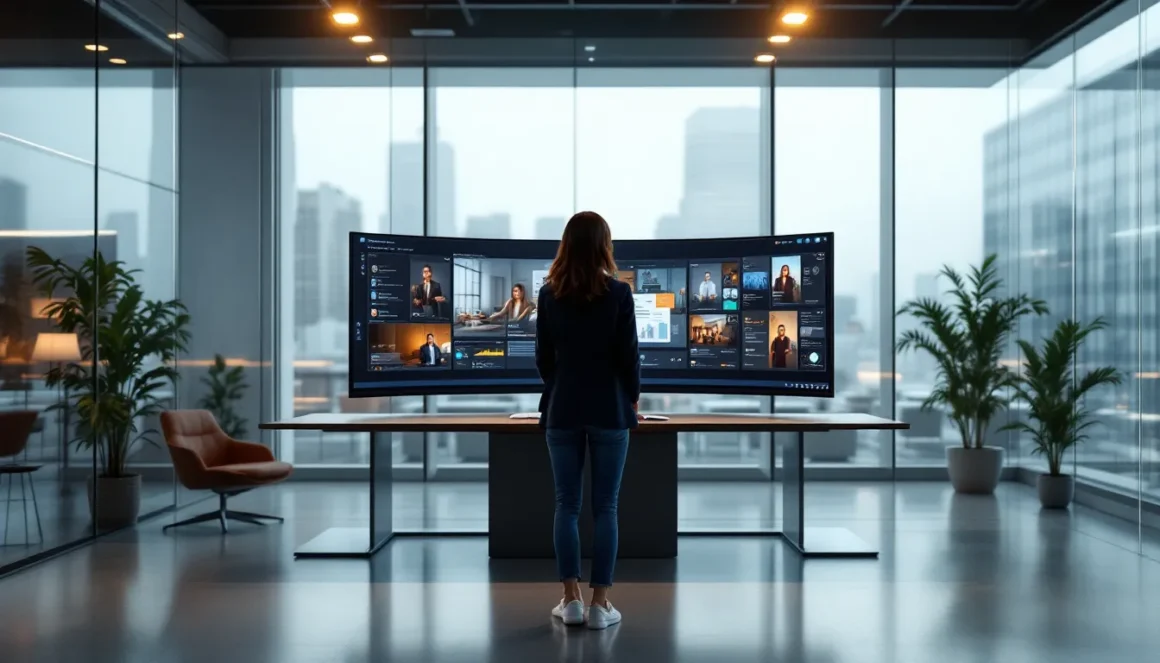
If 2024–2025 were the years you dabbled with AI tools on the side of your “real” work, 2026 is the year your tech stack makes AI the backbone of how marketing actually runs.
You’re moving from batch campaigns and channel silos to real-time decisioning, AI agents, and orchestrated journeys that adapt as fast as your customers do. At the same time, the fundamentals, clear positioning, strong creative, smart measurement, matter more than ever, because mediocre execution gets automated first.
As AI becomes the backbone of modern marketing stacks, the real challenge isn’t access to tools it’s choosing the ones that actually earn a place in production. We’ve broken down the best AI marketing tools based on real workflows, strengths, and where they genuinely outperform traditional platforms.
This Marketing Technology Trends Report 2026 walks you through how the landscape is shifting, where the real opportunities are (beyond the hype), and how to future-proof your stack so you can grow faster without losing control of your brand or your data.
How The Marketing Tech Landscape Is Shifting In 2026

Martech in 2026 is defined less by the logo soup on your slide and more by how well your tools talk to each other in real time.
You’re seeing a clear break from batch-era platforms:
In their place, leading teams are shifting toward real-time architectures and AI agents embedded across the stack:
All of this is bounded by governance: permissioning, approvals, and audit trails that keep you compliant and on-brand even as AI output scales.
High-performing teams are increasingly splitting their stack into two layers:
You use the lab to discover new plays, then promote the winners into the factory where they’re automated, optimized, and monitored. The efficiency gains you get from automation are reinvested into more personalized journeys and micro-segments, rather than simply cutting spend.
Underneath this, Marketing Operations is evolving fast. In 2026, Ops isn’t just owning forms and lead routing. It’s:
You can think of this as Marketing Ops 3.0, a shift from “systems admins” to business value engineers who balance AI fluency, data literacy, and change management. If you want your stack to be an advantage (not a cost center), this is where you invest skills and headcount.
In 2025, you probably framed AI as a productivity booster: faster copy, quicker briefs, lighter analysis.
In 2026, AI becomes core infrastructure for how you grow.
You’re moving from “do the same work faster“ to “do better work you couldn’t do before.“ That shows up in three big shifts:
Surveys show that a large share of marketers, often cited around 46%, use AI to scale creative. But the real step-change in 2026 is agentic optimization at scale: agents continuously testing subject lines, bid strategies, and page variations, then reallocating spend in near real time.
AI isn’t replacing your strategy: it’s turning your strategy into code that runs continuously. Your role shifts from doing every task by hand to designing the systems that decide what happens, to whom, when, and why.
By 2026, you’re operating in a world where traditional tracking has eroded, but expectations for relevance haven’t.
Third-party cookies are largely gone, mobile identifiers are constrained, and platforms are tightening data access. At the same time, regulators and customers expect you to respect privacy and still deliver personalized experiences.
The response isn’t to hoard more raw data: it’s to build clean, well-governed data foundations and smarter collaboration models:
Retail Media Networks (RMNs) are one of the big winners in this environment. Many brands report ~1.8x better results from RMNs compared with some open-web buys, and plan budget increases of 30–35% because the ROI is transparent and close to the point of sale.
With signal loss, your attribution playbook has to evolve:
The takeaway: in 2026, your unfair advantage isn’t perfect tracking, it’s your ability to design experiments, triangulate signal, and make confident calls with imperfect data.
If your automation still looks like one giant nurture flow with 27 branches, you’re behind the curve.
Automation 2.0 in 2026 is about orchestrated portfolios of smaller, smarter journeys that update based on what people actually do, in real time.
Traditional automation:
Automation 2.0 adds three capabilities:
Practically, this means you move from one mega-journey to tens or hundreds of micro-journeys tuned to behaviors: onboarding completions, feature discovery, pricing-page visits, abandoned searches, and more.
To make Automation 2.0 real in your org, you should:
You’re still in charge of the strategy: who you serve, what you offer, and where you’re going. Automation 2.0 just lets you execute that strategy at a level of granularity humans alone can’t manage.
Creative is where many marketers first felt AI’s impact, and in 2026 it’s moved from novelty to core workflow.
Studies across the industry show GenAI already supports roughly a third of work in creative, media, and measurement. In practice, that shows up as:
You’ve probably learned the hard way that left unchecked, AI produces generic, on-the-nose content. The winning teams in 2026 are using agentic creative workflows that keep humans firmly in the loop:
This loop allows you to run real-time ad testing and creative refreshes that would have taken weeks or months before.
One under-appreciated upside: AI can help you audit and improve representation and inclusivity across your assets.
In 2026, your edge isn’t that you use GenAI, almost everyone does. It’s that you’ve built a repeatable, data-informed creative system where human judgment and AI speed amplify each other rather than compete.
Underneath the buzz, a few concrete channel and platform trends are shaping how you architect your marketing stack in 2026.
Retail Media Networks keep surging because they sit closest to the actual purchase. With many marketers seeing 1.8x better performance and planning 35%+ budget increases, your stack needs to:
Another subtle but important shift: you’re no longer just marketing to people: you’re marketing through and sometimes to algorithms and agents.
This makes brand building and community building more, not less, important:
Your 2026 channel strategy is less about chasing every new platform and more about building a flexible core that can plug into wherever attention moves next.
Future-proof doesn’t mean predicting every new tool. It means building an adaptable system that lets you test, learn, and scale faster than your competitors.
Here’s how you can do that in practice.
Formalize the split:
Create explicit promotion criteria for when a tactic, workflow, or tool graduates from lab to factory.
The single customer view is helpful, but in 2026 the differentiator is whether your stack can sense and respond in real time.
You don’t need everyone to be a data scientist, but you do need:
To avoid “Shadow AI” and brand risk, build:
The stacks that win in 2026 aren’t the biggest: they’re the most adaptable.
If you design for adaptability, technically and culturally, you’ll be ready for whatever the next wave of AI and platform changes brings.
Trends change quickly, but the fundamentals of evaluation don’t. Before adopting new platforms, it helps to compare how emerging tools stack up against established options across pricing, automation, and reporting. A practical approach is using a marketing software comparison hub to see where current platforms are evolving.
By 2026, marketing technology isn’t about flashy tools: it’s about how fast and how well you can turn insight into action.
Your differentiation comes from:
You’re operating in an environment where AI, automation, and analytics handle more of the execution. That doesn’t make you less important, it raises the bar on what you do best: strategy, narrative, positioning, and judgment.
If you invest now in a real-time, AI-native, well-governed stack, and in the people and processes to run it, you won’t just keep up with 2026’s marketing technology trends. You’ll be one of the teams setting them.
A modern marketing tech stack guide can help teams understand how to strategically combine technologies, streamline workflows, and build a scalable system that supports long‑term growth and adaptability. Understanding this framework makes it easier to align tools with strategic goals and optimize your tech investments.
The “Laboratory” and “Factory” model
Marketing Ops 3.0: from tool jockeys to value engineers
AI-Driven Marketing Moves From Experiments To Everyday Infrastructure

What this looks like in your day-to-day
The New Data Reality: Privacy, Signal Loss, And Smarter Measurement
Smarter data, not more data
Rethinking measurement in 2026
Automation 2.0: From Basic Workflows To Orchestrated Customer Journeys
From rules to sensing and deciding
What to focus on now
Content, Creative, And The Rise Of Generative Workflows
From “AI writes” to “AI co-creates”
Inclusive and culturally fluent content at scale
Channel And Platform Trends Shaping The 2026 Stack
Video, social, and data gravity
The rise of RMNs and walled gardens
Designing for agents and micro-communities
How To Future-Proof Your Marketing Tech Stack For 2026 And Beyond
1. Adopt the Lab / Factory model
2. Prioritize real-time, not just “single view”
3. Upskill in AI coaching and agile ways of working
4. Put governance and ethics on rails
5. Commit to continuous, small bets
Conclusion
The Big Picture For Modern Marketers In 2026
Key Takeaways